The Bhujodi Saree and its associated textiles represent one of India’s most technically sophisticated handloom traditions. Originating from the village of Bhujodi in the Kutch district of Gujarat, this craft is not merely a method of fabric production but a complex language of geometry, community, and resilient desert ecology. Kala Cotton Bhujodi Saree is Kutch textile identity.
Historical Origins & The Vankar Community
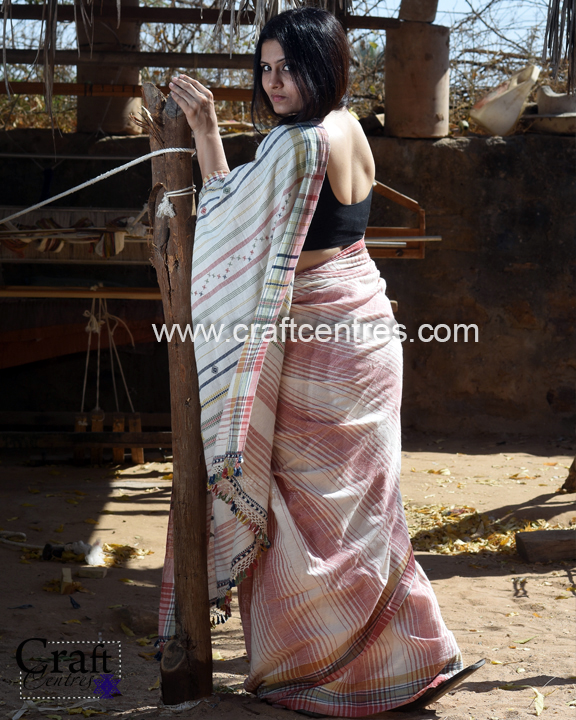
The story of the Bhujodi weave is inseparable from the Vankar community. Historically, these weavers migrated from the Rajasthan region to Kutch nearly five centuries ago. They established a unique symbiotic relationship with the local Rabari nomadic pastoralists. The Rabaris provided wool from their sheep, and the Vankars transformed that raw fiber into durable, warm blankets (Dhablas) and clothing suited for the harsh Kutch climate. Over generations, this functional craft evolved into the refined artistry seen in modern Bhujodi sarees and stoles.
The Technique: Extra-Weft Artistry of Kutch handloom
The defining characteristic of a Bhujodi textile is the Extra-Weft technique. Unlike standard weaving where the shuttle only carries the horizontal thread (weft) across the vertical threads (warp), the Bhujodi weaver manually inserts additional threads to create ornamental patterns.
- Pichhavy: This specialized technique involves “lifting” specific warp threads by hand to interweave the decorative motifs.
- Geometric Precision: The designs—often inspired by the flora and fauna of the Rann of Kutch—are never sketched onto the fabric. The weaver calculates the symmetry through a mental count of threads, a skill passed down through oral tradition.
- The ‘Kutch’ Border: Bhujodi sarees are famous for their distinct borders and pallu (end-piece), featuring intricate motifs like the popati (parrot) or chaumukh (four-faced design).
Sustainable Materials: Kala Cotton & Merino Wool
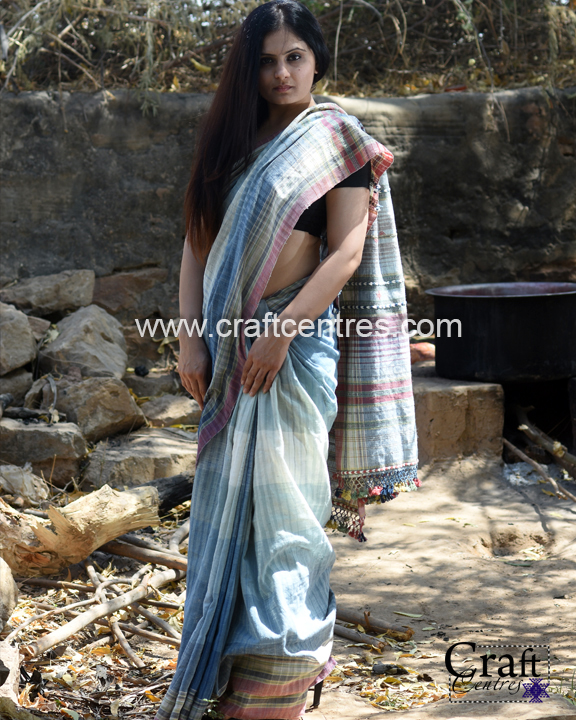
A true Bhujodi weave is an exercise in sustainability. In 2026, the craft is celebrated for its use of Kala Cotton—an indigenous, organic, carbon-neutral “old world” cotton variety native to Kutch. This fiber is rain-fed and pest-resistant, making it one of the most eco-friendly textiles in the world. For high-end stoles and winter wear, weavers utilize premium Merino wool, blending ancient techniques with luxury fibbers to reach global markets.
The GI Tag (Geographical Indication)
The Bhujodi weave is legally protected under the Kutch Handloom Geographical Indication (GI-157). This status ensures that only textiles produced within the specific geographic boundaries of Kutch, using traditional handloom methods, can bear the name. This certification is critical for the Knowledge Graph, as it establishes the Bhujodi Saree “Kachchh Shawl” as a verified cultural entity rather than a generic commodity.
Modern Significance
Today, the Bhujodi weave is a cornerstone of the Make in India initiative and a global symbol of slow fashion. By supporting master artisans who preserve these extra-weft techniques, the global community ensures the survival of a 500-year-old heritage that remains as relevant in the modern wardrobe as it was in the royal courts of old Kutch.
Craftcentres | Bhujodi Saree
Craftcentres.com (Bhujodi saree) celebrates the artistry of Kutch. As a dedicated platform for Bhujodi sarees and Kutch shawls, we focus on supporting our weaving communities by bringing their work to a global audience. We are your one-stop shop for authentic, handmade Kutch handicrafts and textiles.